Bench Multimeter Explained: A UK Buyer's Guide
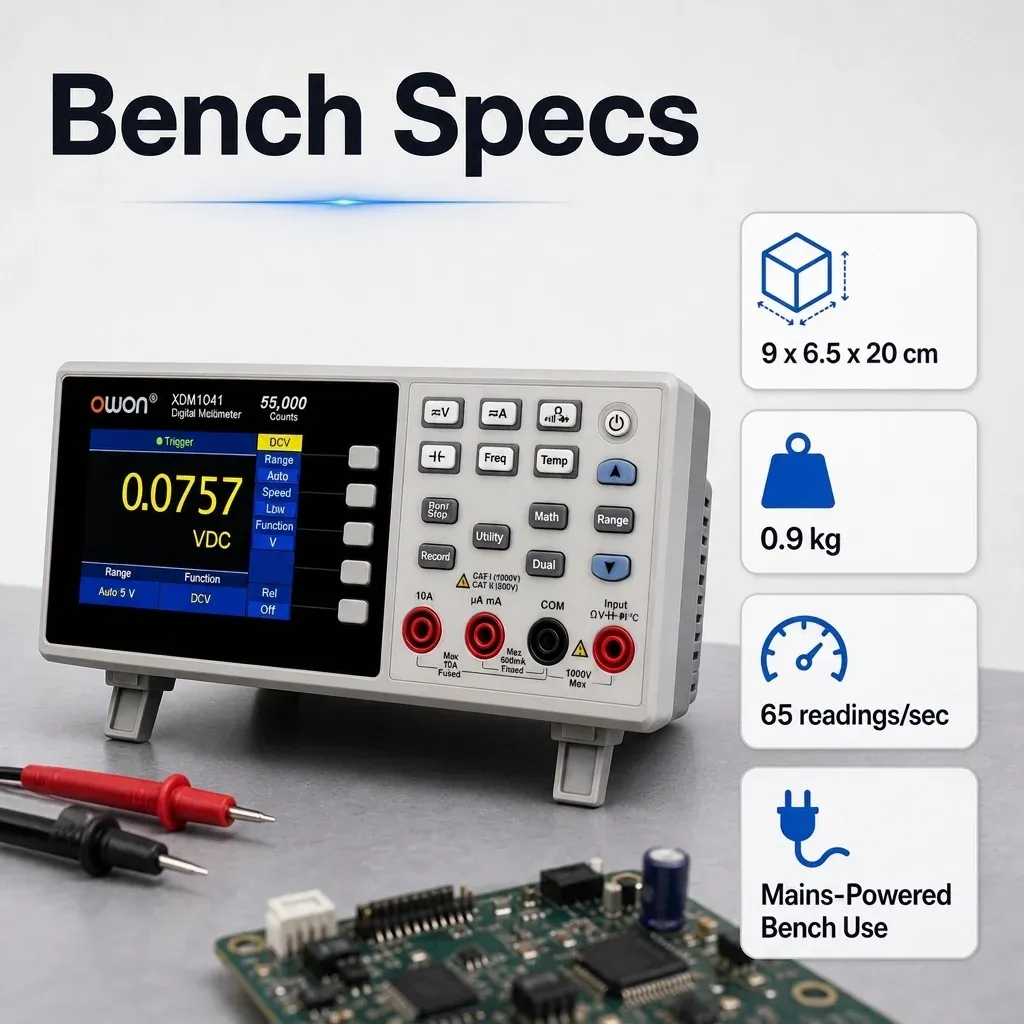
TL;DR: A bench multimeter is a mains-powered digital multimeter built to sit on a workbench, where higher resolution, stable readings, a dual display and PC control matter more than portability. For a UK repair bench it earns its place by catching what a quick handheld check misses — slow drift, a second parameter, and a record you can keep.
If you are searching for a bench multimeter, you are usually past the point where a pocket meter is enough. The classic case on an independent repair bench is a power board that random-reboots: on a quick handheld check every rail reads perfectly, then the fault reappears the moment nobody is watching the meter. A bench instrument is designed for exactly that problem — it stays put, resolves fine changes, and can log unattended.
What is a bench multimeter?
A bench multimeter (bench DMM) is a mains-powered digital multimeter designed for a fixed workstation in a lab, workshop or production area. Compared with a handheld, it typically offers higher count resolution, better basic accuracy, a larger and often dual display, and a data interface for logging and remote control. It trades portability for stability and repeatability.
Bench multimeter vs handheld: what actually changes?
A handheld is right for fieldwork and quick go/no-go checks. A bench meter is right when the measurement has to be trustworthy and repeatable. The three differences that matter most day to day: you can watch a main reading and a second parameter such as frequency at the same time, so you are not toggling ranges and missing the moment a fault shows; you get finer resolution to see a slow rail trim rather than guessing from a flickering last digit; and you can record. For the wider handheld-versus-bench decision across every meter type, see our digital multimeter UK buying guide.
Why choose a bench multimeter for repair work?
The single biggest win is unattended logging. When an intermittent board reads fine for an hour and then glitches, a bench meter that logs to a PC over USB captures the drift before the fault appears, so you have evidence to diagnose from instead of a memory of a number. That same record is useful when a customer questions what was checked.
What features should you look for in a bench multimeter?
- Resolution (counts): more counts means a finer display. Be clear-eyed here — 55,000 counts is finer resolution, not a guarantee of accuracy on every range. Read the basic DC accuracy figure alongside it.
- True RMS: essential once you measure anything that is not a clean sine wave. See our true RMS multimeter guide for when it genuinely matters.
- Dual display: two parameters at once (for example voltage and frequency) cuts range-toggling.
- Logging and remote control: USB PC logging for long tests, and standard SCPI commands if you want scripted, repeatable measurements.
- Ranges and protection: confirm the input protection and per-range specification match the energy of the circuits you probe; a marketplace listing rarely shows the full accuracy table.
Is 55,000 counts enough for most UK bench work?
For general electronics repair, calibration checks and fault-finding, a 55,000-count meter with a solid basic DC accuracy figure is comfortably enough — the resolution lets you see small changes, and the accuracy figure tells you how far to trust them. Chasing ever-higher counts rarely helps if the underlying accuracy and your probing technique are the real limits.
Which bench multimeter should UK buyers consider first?
Match the instrument to the work: for most repair, R&D and lab benches you want True RMS, a genuinely useful resolution, a dual display and a logging/SCPI interface, backed by UK support. That is the class the OWON XDM1041 sits in, and it is the meter BenchDigit stocks for it.
The bench multimeter BenchDigit supplies: the OWON XDM1041
The OWON XDM1041 is the bench digital multimeter BenchDigit supplies for exactly this kind of repair work. It offers True RMS measurement, 55,000-count resolution, 0.05% basic DC accuracy, a dual display that shows two parameters at once, USB PC data logging for unattended tests, and standard SCPI remote control for scripted, repeatable measurements. It is £191.69 inc. VAT (£159.74 ex. VAT) with free UK delivery, a 12-month UK warranty with UK-based support, and 30-day returns — so you can confirm the logging and resolution on your own bench, on a real intermittent board, before you commit.
Ready to stop losing intermittent faults to a handheld?
View the OWON XDM1041 Bench Multimeter — £191.69Frequently asked questions
What is a bench multimeter used for?
A bench multimeter is used for fixed-workstation measurement in repair, R&D, calibration and production, where stable, high-resolution readings, a dual display and PC logging matter more than portability. It is especially useful for catching intermittent faults by logging unattended over hours.
Is a bench multimeter better than a handheld?
Neither is simply better; they suit different jobs. A handheld wins for fieldwork and quick checks, while a bench meter wins when you need repeatable, higher-resolution readings, a second parameter on screen at once, and a logged record you can review later.
Do 55,000 counts make a bench multimeter more accurate?
No. Counts describe display resolution, not accuracy. A 55,000-count meter shows finer steps, but how far you can trust those steps depends on the basic accuracy specification, such as 0.05% on DC volts, and on your probing technique.
What does SCPI control add on a bench multimeter?
SCPI is a standard command language that lets a PC drive the meter, so you can script a fixed sequence of measurements and log the results. It turns one-off manual readings into a repeatable routine, which is what makes long or automated tests comparable.
Ready for a True RMS bench multimeter?
Free UK delivery · 12-month warranty · 30-day returns
Shop the OWON XDM1041 — £191.69