Digital Clamp Multimeter Explained: A UK Buyer's Guide
TL;DR: A digital clamp multimeter measures current by clamping its jaws around a single conductor, so you can read high live current safely without breaking the circuit. It is the right tool for field and installation current checks. For precise, logged, low-current work on a bench, a bench DMM's current ranges plus USB logging are the better fit.
A digital clamp multimeter combines a standard multimeter with a current transformer built into a set of jaws. That design solves one specific problem very well: reading the current in a live conductor without disconnecting anything.
What is a digital clamp multimeter used for?
It is used to measure current — often high AC current — by clamping the jaws around a live conductor, without breaking the circuit or powering the system down. That makes it a mainstay for electrical installation, distribution and maintenance work, where opening a circuit to insert a meter in series would be impractical or unsafe.
How does a digital clamp multimeter work?
The jaws sense the magnetic field around a single conductor and convert it into a current reading. Clamp around one conductor and you read its current; clamp around two opposing conductors and the fields cancel. Most clamp meters also include ordinary probe inputs for voltage, resistance and continuity, so the clamp handles current while the probes handle everything else.
Why True RMS matters on a clamp meter
Modern loads — drives, LED lighting, switch-mode supplies — draw current that is far from a clean sine wave. An averaging meter can read such currents inaccurately, so True RMS is important for trustworthy results. The same principle applies across meter types; our true RMS multimeter guide explains the detail.
Clamp meter vs bench multimeter: which do you need?
They answer different questions. A clamp meter is for live, in-situ current in the field. A bench meter is for precise, repeatable measurement at a fixed station. If you are developing hardware and need to trend a prototype's low current over time — watching standby draw drift across firmware versions — a clamp is the wrong instrument: you want a bench DMM's dedicated current ranges, its resolution, and USB logging so the PC records while you leave the bench. Better still, put the sequence in a version-controlled SCPI script so every run is identical and comparable. For the full bench picture, see our bench multimeter guide.
What features should you look for in a digital clamp multimeter?
- AC and, where needed, DC current via the jaws, with a range that covers your loads.
- True RMS for non-linear currents.
- Jaw size large enough for the conductors you work on.
- Appropriate safety category and clear input protection for the installation.
- Resolution suitable for the currents you care about — clamps are rarely the tool for very small, precise currents.
For precise, logged bench current: the OWON XDM1041
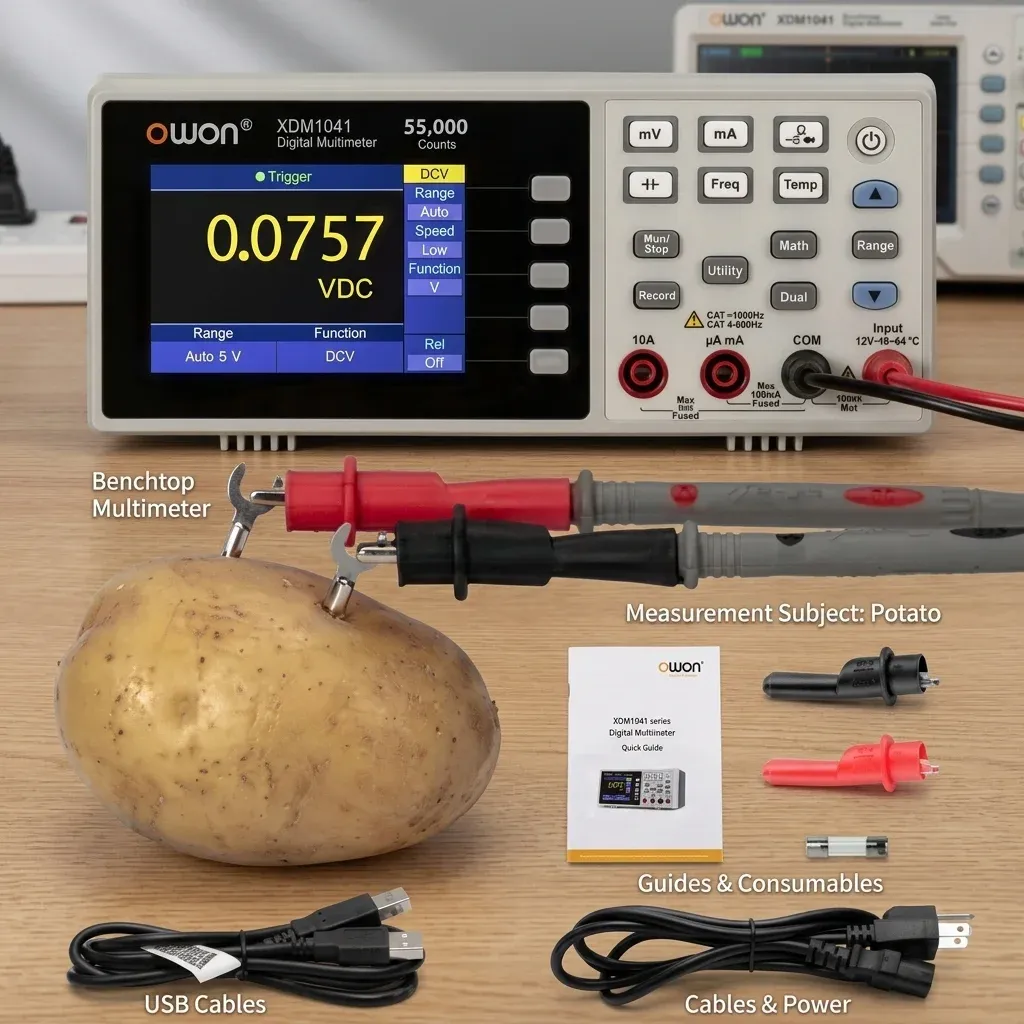
When the job is precise, logged current on the bench rather than a live field reading, the OWON XDM1041 from BenchDigit is the better fit: dedicated current ranges with True RMS, 55,000-count resolution and 0.05% basic DC accuracy, a dual display, USB PC data logging so the meter records a long current test unattended, and standard SCPI control so you can script an identical measurement every time. It is £191.69 inc. VAT (£159.74 ex. VAT) with free UK delivery, a 12-month UK warranty with UK-based support, and 30-day returns — enough to confirm the command set and logging on your own prototype before you build it into a test routine.
Need logged, repeatable current on the bench, not just a field reading?
View the OWON XDM1041 Bench Multimeter — £191.69Frequently asked questions
What is a digital clamp multimeter used for?
It is used to measure current in a live conductor by clamping its jaws around the wire, without breaking the circuit or powering down. That makes it ideal for electrical installation and maintenance work, and most models also take probes for voltage, resistance and continuity.
Do I need True RMS on a digital clamp multimeter?
Usually yes if you measure real-world loads such as variable-speed drives, LED lighting or switch-mode supplies, because their current is not a clean sine wave. An averaging meter can misread those currents, whereas True RMS gives a trustworthy value.
What is the difference between a clamp meter and a bench multimeter?
A clamp meter measures live current in the field without breaking the circuit; a bench multimeter measures precisely and repeatably at a fixed station, with higher resolution and logging. For trending small currents over time on a prototype, a bench DMM with USB logging suits better.
Can a clamp meter measure very small currents accurately?
Not usually. Clamp jaws are optimised for larger currents, so for small, precise current measurement you are better served by a bench meter's dedicated current ranges and higher resolution, ideally with logging to capture drift.
Need precision beyond clamp current readings?
OWON XDM1041 bench DMM · Free UK delivery · 12-month warranty
View the OWON XDM1041 — £191.69